





1 : Constant Voltage or Direct current Voltage (DC)
OR
2 : Alternating Voltage or Alternating current Voltage (AC)
and in common language these are called as DC and AC voltages.
DC voltage is represented in circuits as

Where the (+) and (-) sign indicates polarities. Common source of DC voltages are batteries and cells.
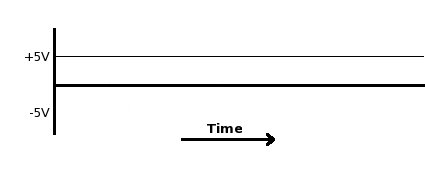
As you can see in the above figure, voltage level of a DC source remains constant, and hence at any time if we measure the value it will be constant.
There is no single symbol to represent AC voltage, but commonly it is represented as

Where the wave symbol inside circle indicates that it is oscillating(alternate) voltage. Common sources are the power connections mounted on house walls.
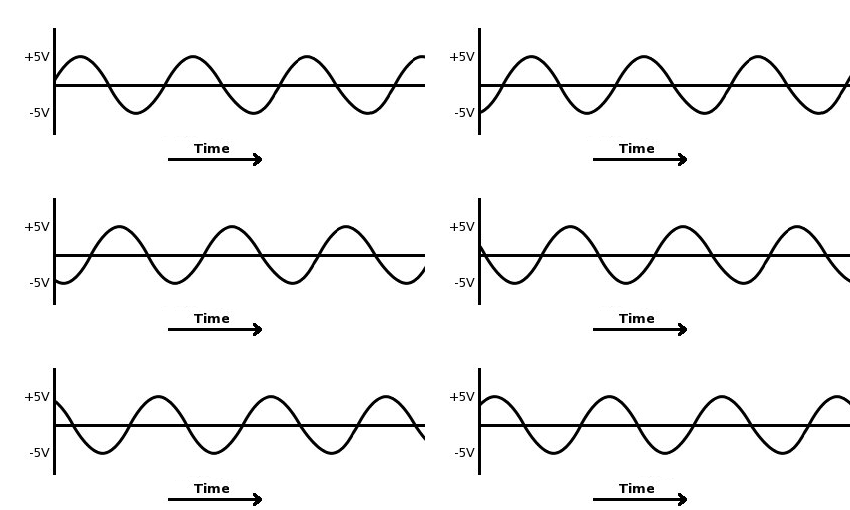
Voltage of an AC source keeps oscillating like a pendulum. In the above figure, the voltage of the AC source keeps varying with time.
The rate at which this voltage varies is known as its frequency. This frequency varies from nation to nation. 50 Hz and 60 Hz are common frequencies.
If a device works on AC power supply, its AC parameters are very important and are generally provided by the manufacturer. You might have seen a small sticker stating voltage and power requirement on many appliances.
NOTE : The differences in voltage and frequency make devices non compatible across countries. For example in US it is 110 volts at 60 Hz and in Asian countries it is 220 volts at 50 Hz. This makes the devices made for US non-working/non-compatible for Asian countries.
Also note that, Voltages from AC to DC and DC to AC can be converted as needed with appropriate adapters or converters.