







Resistor value is marked on each resistor. Since these resistors are so small in size, it is very difficult to write values on them. Hence another interesting method of writing resistor values was invented, which is called color coding. Value of a resistor is represented in terms of the colored rings around it. One can easily decode these color codes to find out actual value of a resistor using the method below.
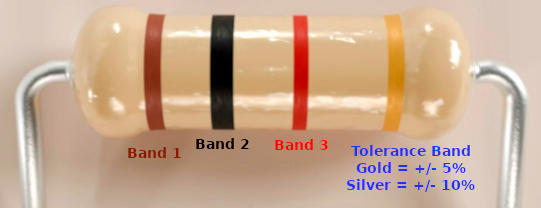
- The resistor shown above has four colored rings, Brown, Black, Red, and Gold. These are called bands.
- The first three color bands are used to compute resistance value and last silver band is use to compute the tolerance.
- Due to the manufacturing process all resistors cannot be manufactured of exact values (color coded value). Hence manufacturer provides error or tolerance percentage. The last band can be Silver or Gold. color indicating 10% or 5% tolerance.
- First three bands can have any color from "resistor color code chart". Each color has its own value as shown in the chart below.
- Value of each color band from the chart is used in the formula to compute resistor value (R).
| Color | Name | Value |
| Black | 0 | |
| Brown | 1 | |
| Red | 2 | |
| Orange | 3 | |
| Yellow | 4 | |
| Green | 5 | |
| Blue | 6 | |
| Violet | 7 | |
| Grey | 8 | |
| White | 9 |
The formula is very simple. Remember that the Third band gives
multiplication factor in power of 10.
R = (Significant Digits) × Multiplier-factor ± Tolerance
Or
R = (Digit1 Digit2) × Multiplier-factor ± Tolerance
Or simply using above table
R = ((band1-value x 10) + band2-value ) x 10 band3-value ± Tolerance
For example, in above figure
band1 is brown, so band1-value = 1.
Band2 is black, so band2-value=0.
And band3 is red, so band3-value=2.
Now the resistor value will be, ((1 x 10) + 0) x102
=> (10 + 0) x 100 => 1000 Ohms or 1K Ohms ± Tolerance.
Since here the tolerance band is gold, the final value will be within 5% tolerance.
1000 +- 5%; (i.e), 1000-50 to 1000+50.which means the actual value of this resistor can be between 950 ohms to 1050 ohms.
Also lets understand the actual reason to put tolerance band on resistors. When a resistor manufacturer produces these resistors, he cannot make these resistor of exact value due to error in machinery, tools and process, hence he marks them with a tolerance indicator so that user can calculate within what range the actual resistance value of a resistor can be expected. Generally circuits are designed considering these tolerance into consideration. There are more precise value resistors available in market and those are called precision resistors but they are more costly compared to the regular ones.
Try Resistor Calculator tool present in the utilities section to test your understanding..